
India just dropped a heavyweight move for electric mobility — a ₹2,000 crore subsidy under the new PM E-DRIVE push to install roughly 72,300 public EV charging and battery-swap stations across cities and highways. It’s a targeted attempt to fix “range anxiety” and speed up EV adoption by making chargers widely available.
Here’s what matters: the subsidy pot is part of a larger EV plan (total outlay reported at ~₹10,000–10,900 crore across the programme). The charging tranche will fund a mix of slow and fast chargers — reports show about 22,000 fast chargers for cars, ~1,800 stations for e-buses, and ~48,000 chargers aimed at two- and three-wheelers. Battery swapping is explicitly included.
The guidelines propose a tiered subsidy and staged payments — 70% at procurement and the remaining 30% after commissioning and integration with a central hub. Certain public entities get extra help: government offices, hospitals, educational institutions and CPSEs may receive 100% subsidy, while transport hubs (airports, railway stations), OMC fuel outlets, metro stations and bus depots are eligible for ~80% subsidy on infrastructure and ~70% on charging equipment. Bharat Heavy Electricals Ltd (BHEL) is the nodal implementer for roll-out.
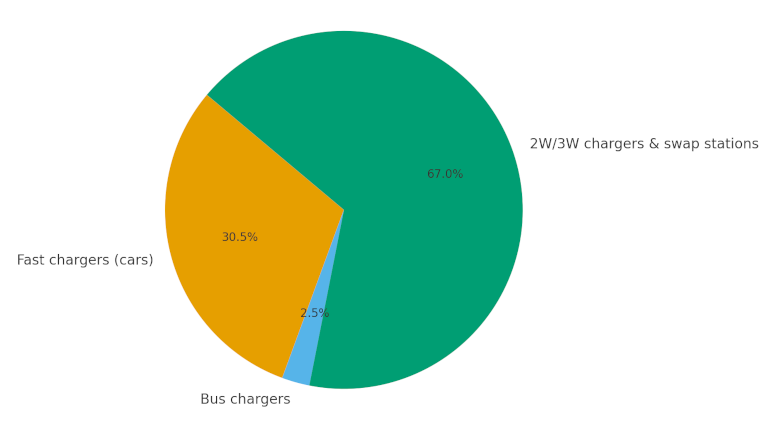
India’s EV mix is heavy on two- and three-wheelers, so the focus on lots of smaller chargers — plus battery-swap sites — suits local demand and lowers per-unit costs for infrastructure builders. The scheme also aims to reduce regional skews by prioritizing highways and major cities where charging deserts are limiting growth.
With a solid plan in place, we have to watch out for the execution speed, land and grid-connectivity at sites, and whether announced budgets translate into live chargers — past tenders have faltered in some states. If the rollout sticks to the plan, India could add tens of thousands of public chargers in the next 12–24 months, a major infrastructure leg for the country’s EV future.
[…] ₹2,000 Crore Boost: Government’s Big Bet to Supercharge EV Charging in India […]
[…] its localization mandates under the PM Electric Drive Revolution in Innovative Vehicle Enhancement (PM E-DRIVE) Scheme, a crucial move that will provide significant breathing room for manufacturers of electric […]