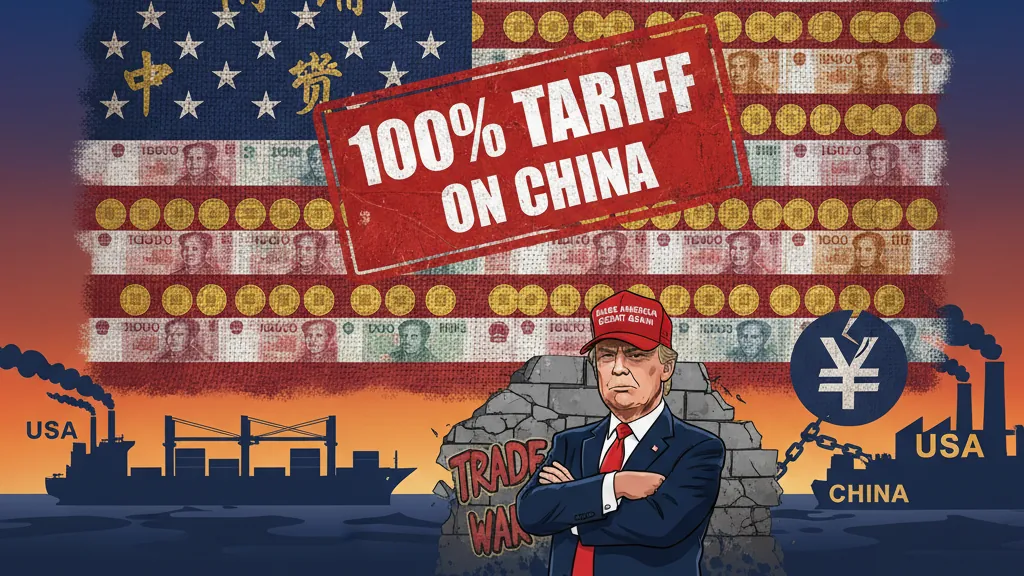
In a dramatic escalation that has sent ripples across global trade corridors, US President Donald Trump announced on October 10, 2025, an additional 100% tariff on all Chinese imports. This fresh volley in the US-China trade saga is slated to take effect on November 1, 2025, or even sooner if Beijing continues what Trump described as “aggressive” trade actions.
This isn’t just a slight nudge; it’s a full-blown economic broadside. With this new measure, the total US tariff on Chinese goods now stands at a staggering 130%, factoring in existing duties of 30%. The announcement, made via Truth Social, also coincides with new US export controls on critical software, marking one of the most sweeping trade actions in recent history. Trump justified the move by citing China’s recent export restrictions on rare earth minerals, which he termed a “hostile act.” These rare earths are crucial for various high-tech US industries, including defense, electric vehicles, and clean energy.
China: A Jolt to the Economic Engine
For China, the immediate effect is expected to be a significant jolt to its export-driven economy. With US tariffs now at 130%, Chinese products will become prohibitively expensive for American consumers and businesses, drastically reducing demand. This will likely lead to a substantial downturn in Chinese exports to the US, which stood at $426.9 billion in 2023. Industries heavily reliant on the American market, such as electronics, textiles, footwear, and solar panels, are bracing for major disruptions.
Economists warn that this tariff hike could trigger price increases worldwide, given China’s pivotal role as a major supplier of industrial and consumer goods. Disruptions in supply chains, particularly for technology, electric vehicles, and defense sectors, are anticipated to ripple across Asia, Europe, and the United States. The Global Trade Research Institute (GTRI) noted that such trade tensions will push up global prices of EVs, wind turbines, and semiconductor parts.
Moreover, the renewed trade war is expected to further dampen China’s economic growth prospects due to setbacks in exports, as highlighted by G. Chokkalingam, founder of Equinomics Research Private Limited. While Beijing has previously shown resilience, a 130% tariff presents an unprecedented challenge, potentially forcing a re-evaluation of its trade strategies and a renewed focus on domestic consumption or diversification of export markets.
India: A Potential Silver Lining?
Amidst the global economic uncertainty, India could emerge as a significant beneficiary. Experts and industry bodies are optimistic that the higher US tariffs on Chinese goods will create a level playing field and shift demand towards Indian products.
Federation of Indian Export Organisations (FIEO) President S.C. Ralhan stated that India “may gain from this escalation,” noting that India exported goods worth $86 billion to the US in 2024-25, making the US its largest trading partner. Sectors such as textiles, toys, and potentially even electronics could see accelerated growth as American buyers seek alternative, more competitively priced suppliers.
For instance, a textile exporter commented that the “100 per cent additional tariff on Chinese goods will give us an upper edge,” opening up “huge export opportunities for India to America.” Similarly, toy exporter Manu Gupta welcomed the move, anticipating that higher duties will create “parity” and a “level playing field,” with American buyers like Target already reaching out for new products. You can view India’s exports to the US trends here.
However, India must also navigate potential challenges. While the immediate opportunity is clear, sustaining these gains will require Indian exporters to scale capacity, ensure stringent quality standards, and align with US compliance requirements. The unpredictability of US tariff policies also presents a subtle risk to market sentiment, as noted by some analysts.
Global Volatility and Policy Dilemmas
The immediate impact has already been felt across global markets, with US stock indices experiencing significant declines and heightened volatility. The S&P 500 dropped 2.7%, the Dow Jones Industrial Average 1.8%, and the tech-heavy Nasdaq Composite 3.6% following Trump’s initial tariff threat. This renewed trade conflict could exacerbate inflationary pressures in the US, making the Federal Reserve’s job even more complex as it grapples with a cooling job market and sticky inflation.
The global economy, still recovering from various shocks, now faces another wave of uncertainty. As the world’s two largest economies lock horns, other nations, including Mexico, Canada, South Korea, Japan, and Singapore, are vulnerable to ripple effects due to their strong trade ties and integration into global supply chains. The coming weeks will reveal how China chooses to retaliate and how swiftly global supply chains can adapt to this new, more protectionist landscape.
Follow DeshkaNews on X (Twitter) to receive updates on the latest post.